How to Export a Translated Play Script for International Submission
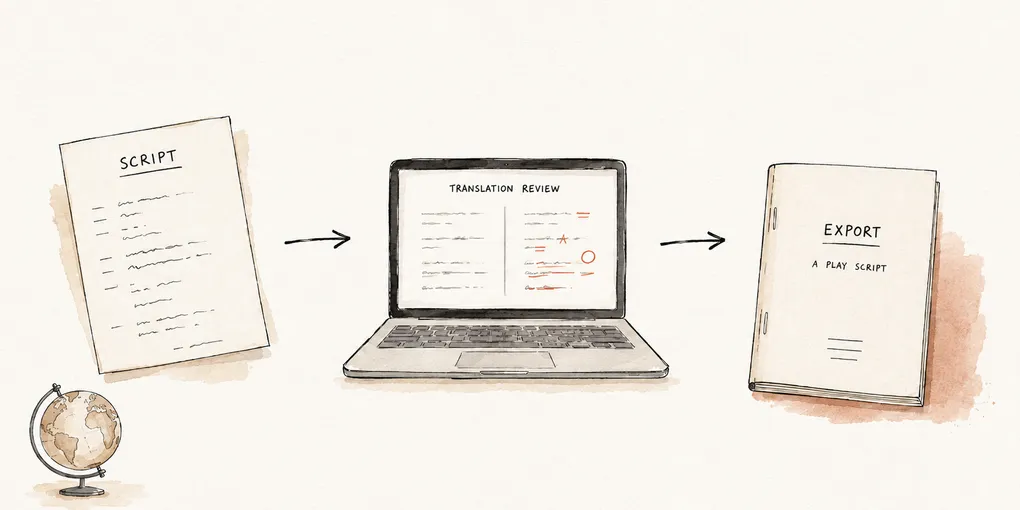
Short answer: A translated play script is ready to export when the target-language lines have been reviewed in context, speakers and stage directions are correctly identified, missing translations are handled deliberately, and the resulting Word document matches the recipient’s requirements. SurtitleLive can export one selected language in a readable .docx layout. The export is a handoff document—not proof that the translation, rights, or submission package is complete.
Sending a play across languages involves more than replacing one sentence with another.
The reader needs to know who is speaking, what is spoken, what is a stage direction, and which version they are reading. The translator needs enough context to preserve voice and dramatic action. The playwright or producing team needs a reliable way to review changes without losing lines between documents.
Formatting matters because it reduces friction. It does not, by itself, make a translation artistically or administratively ready.
That distinction shapes a better workflow: keep the script structured, review the language inside that structure, export a readable copy, and then complete the recipient-specific title page, credits, rights information, and supporting materials outside the export where necessary.
A clean document is not the same as a finished translation
A polished Word file can still contain the wrong voice, a missed joke, an inconsistent name, or a stage direction accidentally treated as dialogue.
Conversely, a strong translation can become difficult to assess if speaker labels drift, paragraphs are merged, or several undocumented drafts circulate at once.
International readers encounter the work through both layers:
- The translation layer: meaning, voice, rhythm, register, humour, cultural context, and performability
- The document layer: speakers, dialogue order, stage directions, spacing, version identity, and readable navigation
Neither layer should be mistaken for the other. Software can help keep lines connected and produce a consistent document. Artistic approval still belongs to the people responsible for the work.
Decide what the recipient actually needs
“International submission” is not one universal format. A festival reader, literary department, translator, dramaturg, co-producer, and rehearsal room may all need different documents.
Before exporting, ask the recipient:
- Which language should the reading copy use?
- Do they want a complete script or an excerpt?
- Do they require a particular file type, page style, or naming convention?
- Should stage directions be included?
- Do they need the original text as a separate reference file?
- Which credits, rights statements, contact details, or declarations are required?
- Is this a reading copy, a review draft, a rehearsal draft, or a performance adaptation?
Follow the receiving organisation’s current instructions. A general blog post cannot replace a festival’s submission rules, a publisher’s house style, or advice about translation and performance rights.
What SurtitleLive’s Word export does
SurtitleLive’s Editor can export a saved script as a Word .docx document. For each export, the team selects one available language.
The Word export offers:
- a colon layout, with the speaker label followed by dialogue
- a centred-character layout, with the speaker name on a separate centred line
- the choice to include or omit recognised stage directions
- a choice for handling missing target-language lines
The missing-translation choices matter. A team can stop the export when translated lines are missing, fall back to source text, leave those lines blank, or mark them for attention. For a submission copy, stopping on missing translations is usually the safest starting point because it makes incompleteness visible before the file leaves the team.
The export uses the script lines and translations saved in the Editor. It creates a readable working document; it does not automatically create a festival title page, character list, rights notice, translator biography, contact sheet, or bilingual parallel edition.
A reliable workflow from source script to reading copy
1. Begin with the clearest source document available
Use a clean Word .docx source where possible. Consistent speaker labels, paragraph breaks, and stage directions give the review team better evidence than an irregular document assembled from scans or copied pages.
Layout is evidence, not truth. A centred line may be a character name, a heading, or something else. Italics may indicate stage action in one script and emphasis in another. Always review the detected structure rather than assuming formatting alone has understood the play.
2. Review speakers, dialogue, and stage directions
Before translating the full work, check the structural decisions that will shape every later output:
- Are speaker names consistent?
- Is spoken text attached to the correct character?
- Are stage directions separated from dialogue?
- Have headings, notes, or front matter been mistaken for spoken lines?
- Are deliberate silences, repetitions, and interruptions preserved?
Correcting the structure early is less risky than repairing several translated exports later.
3. Draft the translation with dramatic context
AI-assisted translation may help produce a first draft, but a play is not a list of isolated sentences. A line can depend on status, relationship, rhythm, physical action, a callback from an earlier scene, or a joke that only works in performance.
Give the translator or reviewer access to the surrounding scene and the purpose of the document. A literal reference translation, a literary reading copy, and a speakable stage adaptation are related but distinct forms of work.
4. Review line by line—and scene by scene
Line-level alignment helps teams find omissions and compare revisions. Scene-level reading reveals whether the target language actually carries the dramatic movement.
Review at least:
- character voice and relationship
- rhythm, interruption, and silence
- idioms, humour, and cultural references
- names, titles, pronouns, and recurring terminology
- stage directions that affect interpretation
- passages intended to be spoken aloud
Where possible, read difficult scenes aloud. A sentence that looks elegant on a page may still be awkward in an actor’s mouth.
5. Resolve missing translations deliberately
Do not let missing text disappear quietly.
For an internal diagnostic copy, marked gaps or source-language fallback may be useful. For an external reading copy, a fail-closed export is usually clearer: the team resolves the gaps first, then produces the file.
If source-language text must remain—for example, a song title, name, or deliberate code-switch—make that an editorial decision, not an accidental fallback.
6. Export one selected language
Choose the language and Word layout that best suits the reader. Include stage directions when they are necessary to understand action, tone, or scene logic.
SurtitleLive’s Word export is a single-language output. If a partner asks for both source and target text, the team can provide separate exports or assemble a bilingual comparison document outside the current Word-export flow. Do not describe a translated-only export as a bilingual edition.
7. Complete the submission package
Open the exported .docx and add or verify any recipient-specific material that is not part of the automatic export:
- translated and original title, if requested
- playwright and translator credits
- translation status and version date
- rights holder or representative
- contact information
- synopsis, character notes, or cultural notes
- required declarations or supporting documents
Keep these facts accurate and proportionate. “AI-assisted draft reviewed by…” is more informative than a vague label such as “final translation” when the work has not received that level of approval.
Choose the right missing-translation policy
The four export behaviours serve different purposes:
| Option | What it does | Sensible use |
|---|---|---|
| Stop on missing text | Prevents an incomplete translated export | External submission or approval copy |
| Fall back to source | Uses source text where translation is missing | Internal comparison, with careful review |
| Leave blank | Omits text for missing target lines | Controlled layout work where blanks are intentional |
| Mark missing text | Keeps a visible marker beside source text | Translator or editor follow-up |
No setting can decide whether an untranslated line is artistically intentional. The team must make that call.
Translated-only, separate files, or bilingual?
A translated-only reading copy is often the easiest document for a reader who does not use the source language. It keeps the dramatic flow clear and avoids doubling the page length.
Separate source and target files can be useful when a translator, dramaturg, or producer needs both versions but does not require line-by-line comparison.
A bilingual parallel document is valuable for close review, but it requires deliberate layout, matching, and version control. SurtitleLive’s current Word export does not automatically build that parallel edition. If one is required, assemble it as a separate editorial deliverable and check that every source segment still matches the correct translation.
The best choice depends on the recipient, not on which format looks most comprehensive.
Treat version labels as part of the translation
Version language shapes how a reader interprets the document. Useful labels might include:
- literal reference translation
- AI-assisted working draft
- translator-reviewed reading copy
- playwright-reviewed submission draft
- rehearsal adaptation
- performance script
Avoid “final” unless the people with authority over the text have actually approved it for the stated purpose.
Use a date or version number in the document and filename. If the source script changes, record whether the translation has been reconciled with that revision. A beautifully formatted old draft is still the wrong draft.
A submission copy is not a surtitle file
A full translated script and a live surtitle or caption file serve different reading conditions.
The script may preserve complete sentences, literary detail, and extended stage directions. Live audience text must be segmented into cues, timed to performance, readable at a distance or on a device, and rehearsed against the actual production.
Surtitles usually translate spoken or sung content for audiences who do not understand the performance language. Accessibility captions may also identify speakers and communicate relevant non-speech sound. A translated script can support both later workflows, but it should not be projected unchanged and called performance-ready.
That separation protects both the writing and the audience experience.
Final review checklist
Before sending the file, confirm:
- The correct language and script version were selected.
- Speakers, dialogue, and stage directions are structurally correct.
- Every missing translation is resolved or intentionally identified.
- Character names and recurring terms are consistent.
- The text has received the level of human review claimed in the version label.
- The Word layout is readable and opens correctly.
- Required credits, rights information, and contact details are present.
- The filename and document identify the version clearly.
- The package follows the recipient’s current instructions.
- No one is presenting a reading copy as a bilingual edition, legal clearance, or performance-ready surtitle file.
FAQ
Can SurtitleLive export a translated play as a Word document?
Yes. The Editor can export one selected source or translated language as a .docx, using either a colon layout or centred character names. The team can choose whether to include stage directions and how to handle missing target-language lines.
Does the Word export include two languages side by side?
No. The current Word export produces one selected language. Provide separate exports or create a separately reviewed bilingual document when parallel text is required.
Does a successful export mean the translation is complete?
No. Export confirms that a document could be produced under the selected settings. It does not certify literary quality, rights clearance, recipient compliance, or artistic approval.
Should stage directions be included?
Include them when the reader needs them to understand action, timing, tone, or scene changes. Follow the recipient’s instructions and check that the directions themselves are correctly identified and translated.
Can the exported script become live surtitles later?
It can become a useful source, but live text needs a separate cueing and rehearsal process. Surtitles and accessibility captions also serve different audience needs, so decide what service the production is actually providing.
What is the safest setting for missing translations?
For an external submission, stopping the export until missing target-language lines are resolved is generally the clearest default. Other modes can support internal review when their use is deliberate and visible.
Export for the next reader, not for the software
The purpose of a translated script is not to demonstrate that a tool produced a file. It is to let another person encounter the play with as little avoidable friction as possible.
Structure makes review traceable. Human judgment gives the language life. Clear versioning tells the truth about what the reader has received.
Used in that order, Word export becomes what it should be: a dependable handoff between artistic teams, not a substitute for translation, permission, or care.
Prepare and review your translated script in SurtitleLive