
Whose Language Leads? Surtitles, Artistic Agency, and Cultural Hospitality
Surtitles are often described as a tool for people who do not speak the language on stage. That description is accurate, but incomplete.
The more revealing question is what happens before the audience arrives. Which language is a company expected to rehearse and perform in? Whose fluency is treated as normal? How much of a work must be reshaped before a wider audience is invited to meet it?
Language access can change those decisions. It can let the language of the performance remain central while giving more people a considered way into the work.
That is not the same as making every difference disappear. A good translation does not turn one language into another without residue. It makes choices about rhythm, humour, reference, tone, and what can be read in the time available. Surtitles are most valuable when they make those choices responsibly—and when they support artistic agency rather than presenting the original language as a problem to solve.
The Language of the Work
Artists sometimes use the phrase “heart language” for the language that feels most intimate or emotionally immediate. The phrase can be meaningful, but no single label can describe every multilingual artist. A person may create in the language of childhood, family, migration, training, neighbourhood, political life, or deliberate artistic experiment. Those languages may not be the same.
The practical principle is simpler:
A company should not have to move a work into the audience’s dominant language simply to make an invitation possible.
Performing in the language in which a piece was conceived can preserve specific vocal rhythms, social registers, wordplay, and relationships between performers. It may also let artists work with the language in which their craft is strongest.
Surtitles cannot preserve every detail. They can, however, let the original performance lead while the translation offers a parallel reading path.
Translation as Cultural Hospitality
Hospitality is not assimilation. A host does not erase the character of a place so that every guest encounters something familiar. The host makes entry possible, explains what needs explaining, and leaves room for discovery.
Theatre translation can work in the same way:
- the original language remains audible and artistically central;
- the translated text is edited for reading during live performance, not treated as a transcript;
- cultural references are handled with enough context to be legible, without flattening every unfamiliar element;
- audiences are told clearly what language service is available and how to use it;
- the production accepts that understanding can be supported without making every viewer’s experience identical.
This approach asks more of translation than literal accuracy. It requires dramaturgical judgment: what must be carried across, what can remain productively unfamiliar, and how much text an audience can read without losing the stage.
A Calgary Collaboration in Cantonese
The Calgary Hong Kong Arts & Culture Association is an Alberta not-for-profit organization that supports Hong Kong artists in Calgary and uses arts activity to build cultural connection.
In a collaboration with SurtitleLive, the association prepared an original-language Cantonese theatre performance with English text available to audience members on their own devices.
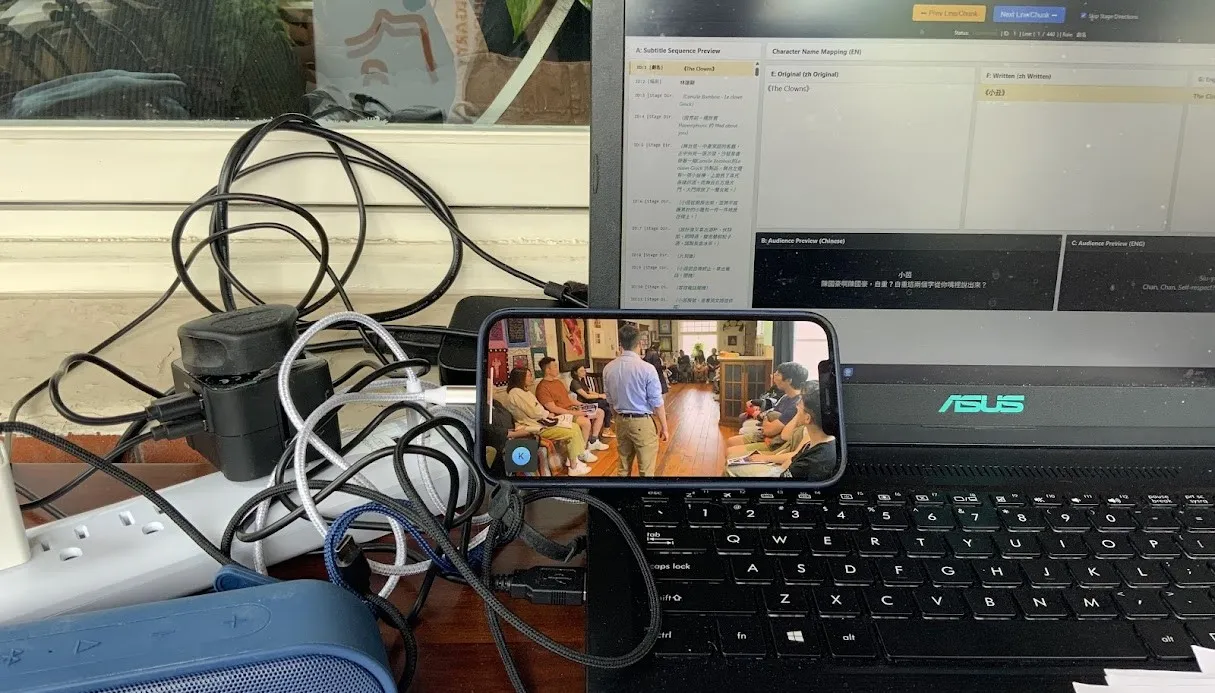 An audience-viewer setup used during the collaboration.
The important design choice was not simply that English appeared on a screen. It was that Cantonese did not have to become secondary in order for English-reading audience members to be invited.
The actors could perform the Cantonese work as a Cantonese work. The English text created an additional route through the performance. Neither language needed to pretend to be the other.
This is a modest claim, and a meaningful one. Surtitles do not prove that every audience member understood every reference, nor can a delivery platform measure the artistic quality of a performance. What they can do is change the terms of the invitation: “You may not know this language, but the work has prepared a way for you to enter.”
Inclusion Is More Than Adding a Language Menu
Offering a translation track can broaden language access. It does not automatically make a production inclusive or accessible in every other sense.
A mobile viewer may help a company work in a community venue without installing a central screen. It may also create barriers for people without a suitable phone, battery, connection, or confidence using the interface. A projected translation can offer a shared, device-free path, but only where sightlines and language capacity are adequate.
Translation surtitles and accessibility captions are also not interchangeable. Deaf and hard-of-hearing audiences may need same-language captions that identify speakers and meaningful sounds, in addition to or instead of translated dialogue.
The production still needs to ask:
- Who is being invited, and who might remain excluded?
- Can people learn about the language service before buying a ticket?
- Is the text readable from the actual audience position or device?
- Who will assist a patron who cannot use the planned delivery path?
- Does the translation respect the work’s voice without requiring cultural knowledge the audience has not been given?
- Has the company budgeted paid time for translation, editing, rehearsal, operation, and audience support?
Language access becomes a practice of inclusion only when those questions remain visible.
What Technology Should—and Should Not—Do
For community and independent companies, the useful technology is often the technology they can genuinely operate. A browser-based workflow can reduce specialist hardware needs, while projection can preserve a shared reading experience. A hybrid can serve different audience needs when the team has the capacity to prepare and rehearse both.
The platform should make those choices possible. It should not dictate the artistic language, claim that one delivery method suits every audience, or hide the labour required to prepare good text.
SurtitleLive can help teams prepare language tracks and deliver them through projection or an audience browser, depending on the production setup. The translation still needs human editorial judgment. The live cues still need an operator. The venue and company still own the audience experience.
That division of responsibility matters. Technology serves cultural work best when it expands artistic possibility without making itself the author of the outcome.
More Than Understanding the Plot
Theatre language access is sometimes justified only in terms of comprehension: the audience needs enough information to follow what happens next.
Plot matters, but the larger value is participation. A person can hear the cadence of a language they do not speak, watch performers work within its rhythms, read a thoughtful translation, and encounter a community on terms that are not entirely their own.
Surtitles do not eliminate the distance between languages. At their best, they make that distance possible to cross without pretending it was never there.
That is more than translation as a utility. It is translation as cultural hospitality: the work keeps its voice, and the door is made wider.
Key Takeaways
- Surtitles can let the original performance language remain artistically central while offering another audience a parallel reading path.
- Translation is an editorial and dramaturgical act; it cannot preserve every rhythm, joke, reference, or social register without making choices.
- Language access does not automatically create complete inclusion or accessibility, and translated surtitles are not interchangeable with same-language accessibility captions.
- Technology should expand a company's delivery choices without deciding the artistic language or hiding the paid work of translation, rehearsal, operation, and audience support.
Frequently Asked Questions
How can surtitles support artistic agency?
They can allow a company to perform in the language of the work while giving other audience members a considered translation path. The original language does not need to become secondary simply to make an invitation possible.
What does translation as cultural hospitality mean?
It means making entry possible without erasing difference: keeping the original language audible, editing the translation for live reading, giving necessary context, and leaving room for audiences to encounter something unfamiliar.
Do translated surtitles make a production fully accessible?
No. Language access is one part of inclusion. Deaf and hard-of-hearing audiences may need same-language captions with speaker and sound information, while mobile and projected delivery can each create different barriers.
What role should surtitle technology play?
It should give teams workable projection, browser, or hybrid options. Human editors still shape the translation, operators still cue the live text, and the venue and company remain responsible for the audience experience.
Glossary of Terms
- Artistic agency: The ability of artists and companies to make meaningful choices about the language, form, and presentation of their work.
- Cultural hospitality: An approach that helps audiences enter a work without requiring its language or cultural character to be assimilated into the familiar.
- Surtitles: Edited performance text shown through a shared display or personal viewer, often to translate live dialogue.
- Accessibility captions: Same-language text that may include speaker identification and meaningful sound information for Deaf and hard-of-hearing audiences.
- Dramaturgical judgment: Editorial choices about meaning, rhythm, context, and how much text an audience can read while still attending to the stage.